


Foreign Trade Market: From Market Shifts to
Model Transformation
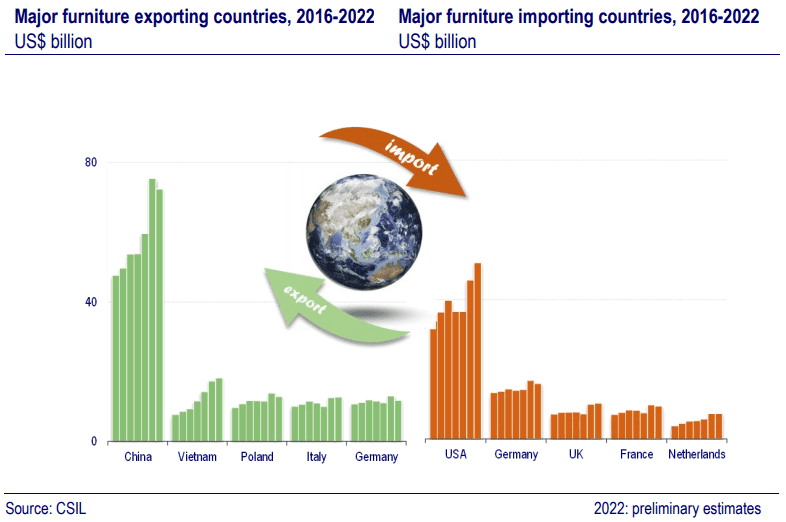
China is the world’s largest furniture
producer. According to CSIL’s World Furniture Outlook, China accounted for
nearly 40% of global furniture output in 2017, with exports representing
roughly one-third of total production capacity.
By 2025, however, furniture exports face a
new reality: tariff barriers, geopolitical tensions, and volatile shipping
costs have become the norm. More fundamentally, global industry division is
being reshaped, with higher environmental standards, compliance costs, and IP
protection weakening the viability of low-price, scale-driven growth.
1、Changes in Export Structure and Target
Markets
In the first three quarters of 2025, China’s furniture exports totaled
USD50.177 billion, down 4.6% year-on-year and broadly flat versus 2023 (CNFA).
Two key trends stand out:
(1)More diversified export markets
Data from Furniture Today shows that direct exports to the U.S. declined
steadily from 27.5% in 2022 to 23.3% in 2025, hitting a low of 17.3% in May
2025 before rebounding in October.
Meanwhile, exports to ASEAN countries are
rising sharply. OEC data shows the fastest growth in non-wood furniture
components from China to Vietnam, Malaysia, and Singapore between 2023 and
2024.
This trend is clearly reflected at CIFF
Guangzhou, where Southeast Asian buyers—especially from Vietnam and
Malaysia—now make up a growing share of procurement orders, offsetting declines
from Europe and the U.S.

(2)Cross-border e-commerce and bonded
logistics buck the trend
According to CNFA’s Q3 2025 report, while
general trade still dominates exports, its share is declining. Bonded logistics
and cross-border e-commerce reached USD3.757 billion, accounting for 7.5% of
exports—up over one percentage point from previous years.
This signals a shift away from bulk
shipments toward flexible, small-batch, fast-delivery models.
2、Opportunities Behind the Changes
(1)Growth potential in non-U.S. markets
While some export shifts are attributed to
transshipment, research suggests that only 30% of growth in non-U.S. markets
comes from short-term rerouting, with 70% driven by genuine demand growth
(Shenwan Hongyuan).
As urbanization accelerates and investment
rises in emerging economies, Chinese exporters must move from passive capacity
relocation toward proactive localization strategies.
(2)Cross-border e-commerce as a structural
growth engine
Despite skepticism, platforms such as
Wayfair, Amazon, Alibaba, and TEMU are rapidly increasing furniture penetration
worldwide. Platform investment and consumer behavior shifts make this trend
irreversible.
Furniture companies must treat cross-border
e-commerce not as a side channel, but as a way to build direct customer access,
brand presence, and data insight.

(3)Upgrading the global positioning of going
global
Low-price competition is no longer
sustainable. Long-term winners invest simultaneously in R&D, design,
patents, and branding, building defensible value.
Functional sofa ODMs that have strengthened
original design and patent portfolios now command stable premiums in North
America and Europe—pointing to a new normal for global expansion.
Reading Industry Change Through Exhibitions:
Greater Differentiation, Emerging Niche
Opportunities
In 2025, exhibition differentiation
accelerated. Ill-positioned shows saw declining participation, while leading
exhibitions continued attracting high-quality exhibitors.
1、From Style Showcases to Category Growth
Platforms
Trends now emerge first on social media,
with exhibitions serving as validation stages. More importantly, exhibitions
have become launchpads for high-growth categories such as functional sofas, modular
customization, and light premium customization.
Through sustained support for smart sleep,
wellness, and senior-friendly products, China International Furniture Fair
(Guangzhou) has helped shape multiple industry growth hubs.
2、Blurring Lines Between Domestic and Export
Markets
Domestic players are expanding overseas,
while export-focused firms explore local retail channels. Each faces capability
gaps—making exhibitions critical platforms for cross-market empowerment and
reduced trial-and-error costs.

March in Guangzhou:
A Forward-Looking Window into Industry
Opportunities
Pressure will persist, but opportunity lies
in structural change. As the first major exhibition of 2026, CIFF
Guangzhou—held March 18–21 (Home Furniture) and March 28–31 (Office, Commercial
& Machinery)—offers a key vantage point.
Under the theme ‘Chain Innovation’, the
2026 edition emphasizes sustainability, smart living, and aging-friendly
solutions, alongside design-driven value creation and global ecosystem
expansion.
For 2026, the message is clear: don’t
wait—act. Capture niche domestic demand, diversify export channels, embrace
cross-border e-commerce, and leverage exhibition platforms to integrate
resources and upgrade capabilities.
When change accelerates, decisive action is
the only way to uncover new growth—and win the future.


